Communication Doesn’t Happen in Quiet Rooms
Traditional microphones perform well in controlled environments.
Real life is different.
Smart glasses are often used in:
- Busy streets
- Airports
- Warehouses
- Cycling routes
- Outdoor activities
These environments generate significant background noise that can interfere with communication.
Noise-canceling microphones help solve this problem.
What Are Noise-Canceling Microphones?
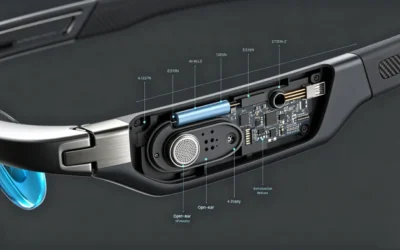
Noise-canceling microphones use multiple microphones and intelligent signal processing to separate the user’s voice from surrounding sounds.
The system identifies:
- Speech signals
- Wind noise
- Traffic noise
- Crowd noise
- Environmental interference
and prioritizes the user’s voice.
The result is clearer communication.
How Noise Cancellation Works
Many smart glasses use dual-microphone or multi-microphone systems.
One microphone focuses on capturing speech.
Another microphone monitors environmental noise.
Software algorithms then compare both signals and reduce unwanted sounds.
This process happens continuously during calls and voice interactions.
Benefits for Smart Glasses Users
Clearer Phone Calls
The person on the other end hears more of your voice and less background noise.
Better Voice Assistant Performance
Voice assistants rely on accurate speech recognition.
Noise reduction improves command accuracy.
Improved AI Translation
Translation systems require clean voice input.
Noise-canceling microphones help improve recognition and translation quality.
Greater Confidence
Users are more likely to use smart glasses for communication when they trust the audio experience.
Why It Matters for Wearables
Unlike smartphones, smart glasses place microphones farther from the mouth.
This makes noise management even more important.
Without advanced microphone technology, communication quality would suffer significantly.
Noise-canceling microphones help bridge this gap.
They allow smart glasses to deliver communication experiences that feel natural and reliable.
The Future of Voice Interaction
Voice is becoming one of the primary interfaces for wearable technology.
As smart glasses continue evolving, technologies such as:
- AI assistants
- Translation
- Real-time coaching
- Context-aware computing
will depend increasingly on accurate voice capture.
Noise-canceling microphones will remain a critical part of this evolution.
Explore Smart Audio Solutions
Learn how advanced microphone technology improves communication, productivity, and wearable experiences in smart eyewear.







Downloading the apklatribet app was completely hassle free and it saves me so much time compared to using a browser. The push notifications for new matches are a nice touch and I never miss a good betting opportunity. Solid platform with a loyal community behind it. apklatribet