The Problem with Traditional Earbuds
For years, personal audio has been dominated by earbuds and headphones.
They deliver immersive sound, noise isolation, and portability.
But they also create an important problem:
They block environmental awareness.
For many situations, this becomes inconvenient — or even dangerous.
Cyclists need to hear traffic.
Commuters need awareness in crowded environments.
Outdoor runners need spatial perception.
Workers need communication without isolation.
This is where open-ear audio is changing the wearable experience.
Instead of sealing sound inside the ear canal, open-ear smart glasses allow users to listen while remaining connected to their surroundings.
And that difference fundamentally changes how wearable audio fits into daily life.
Smart Glasses Are Creating a Different Audio Experience
Traditional audio devices are designed for immersion.
Smart eyewear often prioritizes something different:
balance.
The goal is not always maximum isolation.
Instead, it is:
- communication
- awareness
- comfort
- convenience
- hands-free usability
This is why open-ear smart glasses are becoming increasingly popular for:
- cycling
- commuting
- outdoor sports
- office communication
- AI translation
- navigation prompts
- voice assistants
The experience feels more natural because users remain connected to their environment.
This is especially important for wearable products designed for extended use.
Unlike headphones, smart glasses are often worn continuously throughout the day.
That changes how audio should behave.
Situational Awareness Is a Major Advantage
One of the biggest benefits of open-ear audio is situational awareness.
Users can:
- hear approaching vehicles
- communicate naturally
- remain alert outdoors
- maintain environmental perception
For cyclists, this is particularly valuable.
Traditional earbuds may reduce awareness of:
- traffic
- horns
- pedestrians
- other riders
Open-ear smart glasses reduce this problem by allowing environmental sound to remain audible.
This creates a safer and more practical riding experience.
The same principle applies to:
- urban commuting
- warehouse environments
- jogging
- outdoor work
- industrial applications
In many cases, wearable audio should assist awareness rather than replace it.
Why Comfort Matters More in Wearable Audio
Ear fatigue is another reason users increasingly prefer audio glasses over earbuds.
Many people experience discomfort after long-term earbud use:
- ear pressure
- irritation
- sweat buildup
- instability during movement
Smart glasses avoid direct ear canal contact entirely.
This makes long listening sessions feel less intrusive.
For wearable products, comfort directly affects:
- usage frequency
- user satisfaction
- long-term adoption
This is especially important because smart glasses are not occasional-use gadgets.
They are becoming:
daily wearable platforms.
And daily products must feel natural over time.
Open-Ear Audio Is More Complex Than It Looks
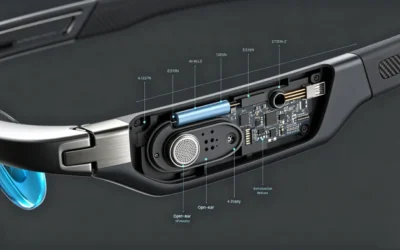
Although open-ear audio feels simple to use, the engineering behind it is surprisingly difficult.
Unlike earbuds, speakers in smart glasses sit away from the ears.
This creates multiple acoustic challenges:
- sound leakage
- outdoor wind interference
- directional sound control
- low-frequency limitations
- privacy concerns
Speaker placement becomes critical.
Even small changes in temple angle or distance from the ear can affect:
- volume perception
- clarity
- bass response
- listening privacy
This is why wearable acoustics has become an important part of smart eyewear development.
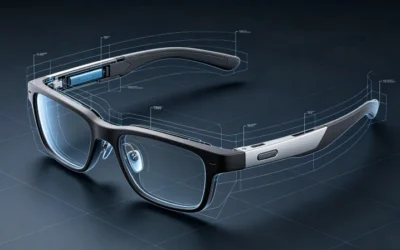
Good audio glasses are not simply “glasses with speakers.”
They require careful tuning between:
- hardware
- frame geometry
- acoustic pathways
- DSP algorithms
- real-world movement
Why Open-Ear Audio Fits the Future of Smart Eyewear
As smart glasses evolve, audio is becoming one of the most important wearable interfaces.
Voice assistants, AI translation, notifications, navigation prompts, and communication features all rely on seamless audio interaction.
Open-ear audio supports this naturally because it blends technology into daily behavior.
Users can:
- listen briefly
- respond quickly
- maintain awareness
- avoid constantly removing earbuds
This creates a more fluid wearable experience.
The future of smart eyewear is likely to become:
less immersive,
more integrated,
and more context-aware.
Open-ear audio supports that direction perfectly.
The Best Audio Wearables Don’t Interrupt Real Life
Many wearable technologies attempt to replace reality.
The best smart eyewear often works differently.
It enhances daily life without disconnecting users from their surroundings.
That is why open-ear audio is becoming such an important category within smart glasses.
It is not only about listening.
It is about balancing:
technology
+
comfort
+
awareness
+
wearability.
And ultimately, that is what modern smart eyewear should achieve.
Explore Audio Smart Glasses
Discover open-ear smart eyewear solutions designed for cycling, commuting, communication, and all-day wearable comfort.







This app has quietly become my favorite spot for quick gaming sessions. The graphics are buttery smooth and I absolutely love the daily free spins feature. It feels like the developers really care about what regular players want. Trust me, you will fall in love with how seamless everything runs. jl888app