Introduction: The Critical Role of Waveguide Optics in Smart Glasses
Waveguide optics serve as the fundamental optical engine in smart glasses and AR devices, functioning as the transparent “bridge” that projects digital images from micro-displays directly into the user’s field of view. Unlike traditional optical systems, waveguides enable a sleek, eyeglass-like form factor while delivering augmented visual information.
This technology isn’t just about making images visible—it’s about balancing optical performance, wearability, manufacturability, and cost in a single component that must meet both technical specifications and human factors. Understanding waveguide parameters is essential for product designers, engineers, and technology decision-makers evaluating smart glasses solutions.
1. Optical Performance Parameters: Defining Visual Quality
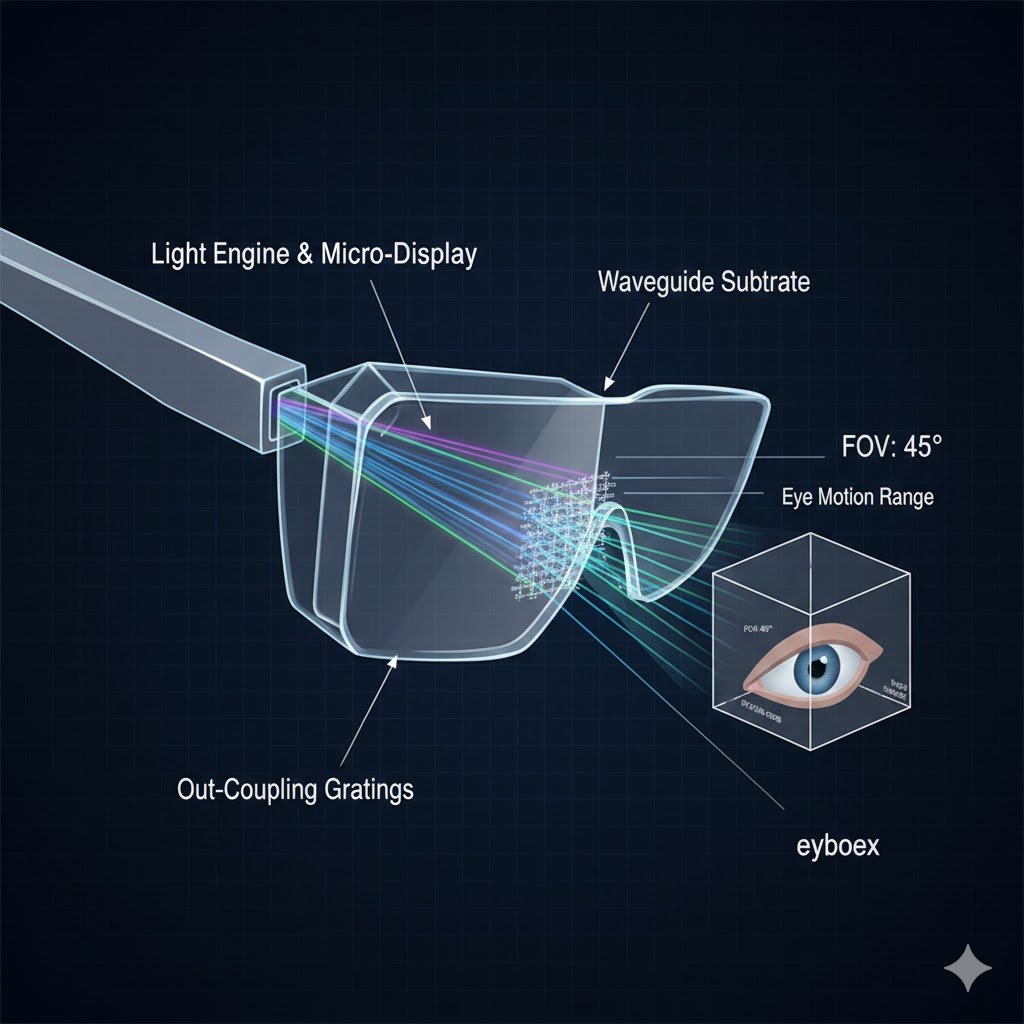
Field of View (FOV)
- Definition: The angular extent of the visible image, measured diagonally in degrees
- Significance: Directly determines immersion level and information density. Larger FOV enables more extensive AR overlays and larger virtual objects
- Typical Ranges: Consumer devices typically operate between 15°–50°, with enterprise solutions sometimes reaching 60°+
- Technical Trade-off: Increasing FOV often requires thicker waveguides or advanced optical designs
Eyebox (Eye Motion Range)
- Definition: The 3D volume in front of the waveguide where the user’s pupil can receive the full image
- Components:
- Exit Pupil Size: Physical dimensions of the light window
- Exit Pupil Distance: Distance from waveguide surface to the eyebox
- Critical Importance: Large eyebox enables comfortable, forgiving alignment—users don’t need perfect positioning to see the full display, significantly improving usability
Brightness & Optical Efficiency
- Definition: Percentage of light from the source that reaches the user’s eye
- Key Considerations:
- Outdoor use requires 1,000+ nits for visibility
- Higher efficiency enables longer battery life or smaller power systems
- Typical waveguide efficiency ranges from 1–10% depending on technology
- Manufacturing Impact: Efficiency directly correlates with production precision and material quality
Resolution & MTF (Modulation Transfer Function)
- Resolution: Total addressable pixels in the display system
- MTF: Measures optical system’s ability to transfer contrast at various spatial frequencies
- User Experience Impact:
- High MTF prevents blurriness and edge distortion
- Insufficient resolution creates “screen door effect” (visible pixel structure)
- Minimum acceptable: 30+ cycles/degree for readable text
Color Performance & Uniformity
- Color Gamut: Range of displayable colors (typically targeting sRGB or DCI-P3)
- Color Uniformity: Consistency across the entire FOV
- Luminance Uniformity: Evenness of brightness across the image
- Critical Failure Points: Color shifts or brightness variations create visual artifacts and user discomfort
2. Geometric & Structural Parameters: The Wearability Equation
Thickness & Volume
- Current Standards: Advanced waveguides achieve 1–3 mm thickness
- Design Constraints: Thinner profiles enable fashion-forward designs but limit optical performance
- Material Impact: Glass substrates typically offer better optical properties but increase thickness versus polymer alternatives
Weight
- Direct Correlation: Thinner/lighter waveguides enable all-day wearability
- User Experience Threshold: Total glasses weight should remain under 50 grams for prolonged comfort
- Material Innovation: Development of high-index, low-density optical materials is critical for next-generation designs
3. Manufacturing & Production Parameters: From Lab to Market
Fabrication Methods & Materials
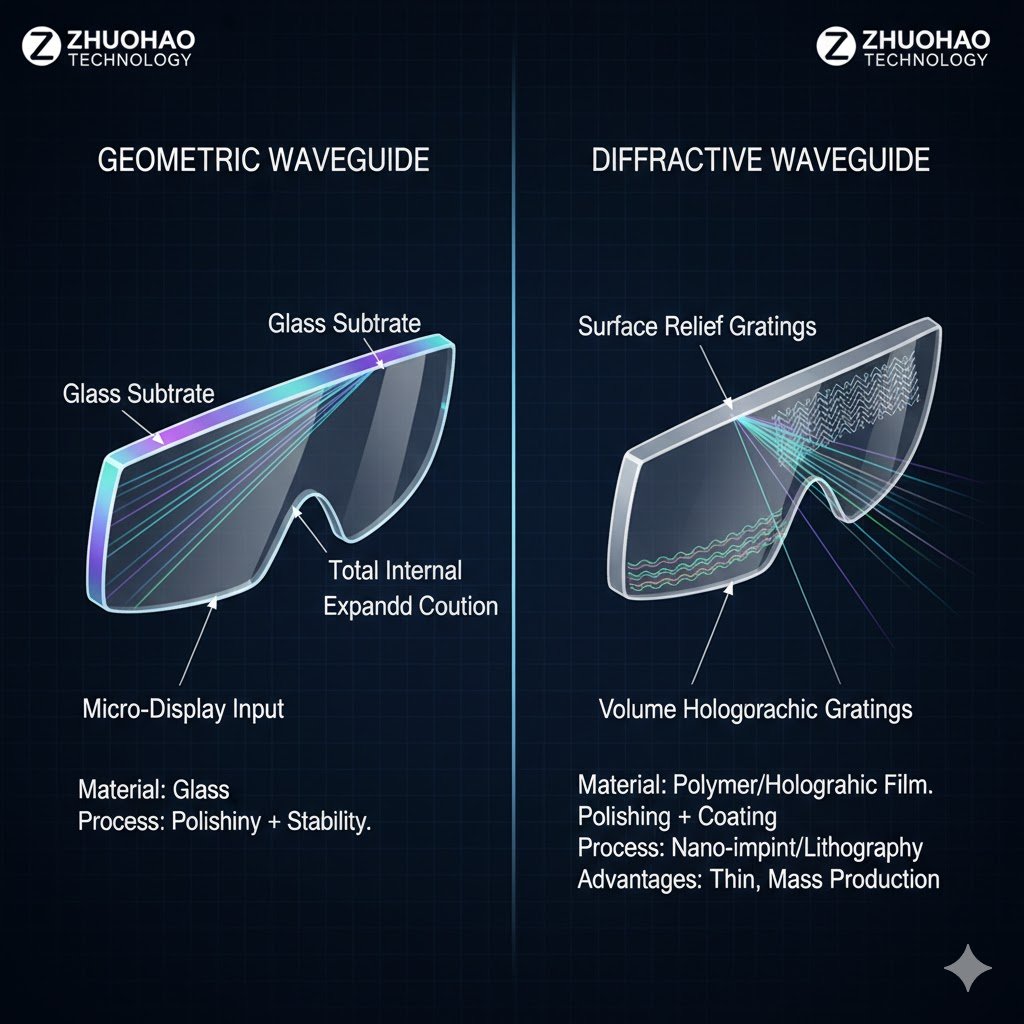
Geometric Waveguides
- Material: Optical-grade glass
- Process: Precision cutting, polishing, and coating
- Advantages: Excellent optical clarity, thermal stability
- Challenges: Higher weight, manufacturing complexity
Diffractive Waveguides
- Subtypes:
- Surface Relief Gratings: Nano-imprint lithography on glass/polymer
- Volume Holographic Gratings: Photosensitive materials (photopolymers, liquid crystals)
- Advantages: Thinner profiles, mass production potential
- Challenges: Color uniformity, angular sensitivity
Yield & Cost Considerations
- Yield Drivers: Alignment precision, defect density, material consistency
- Cost Structure:
- Material costs: 20–40%
- Processing costs: 30–50%
- Testing/QA costs: 20–30%
- Economies of Scale: Significant cost reduction possible at 100k+ unit volumes
4. Parameter Interdependencies & Design Trade-offs
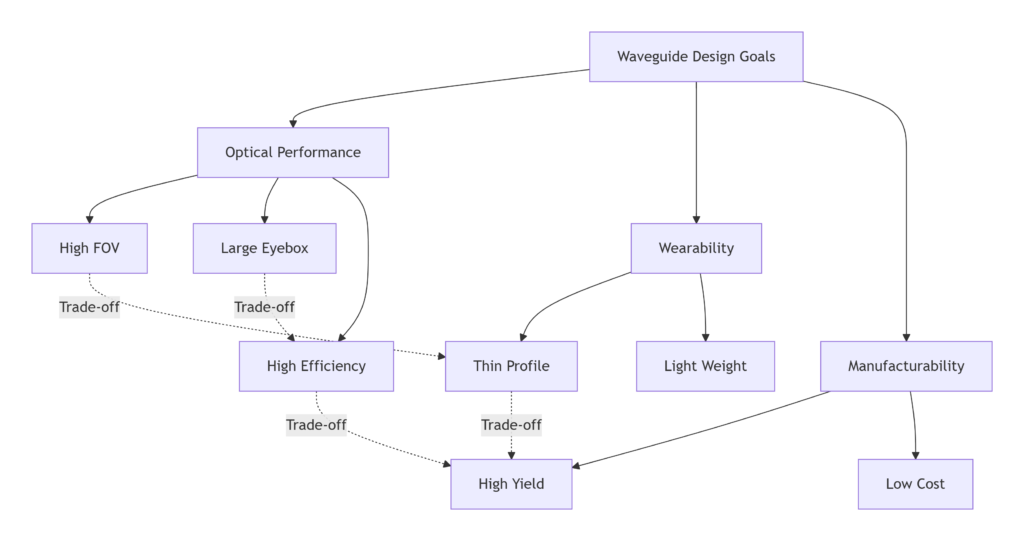
The Fundamental Balancing Act
Key Technical Trade-offs
| Parameter Pair | Relationship | Design Implication |
|---|---|---|
| FOV vs. Thickness | Generally proportional | Larger FOV requires thicker waveguides or advanced optics |
| FOV vs. Eyebox | Often inversely related | Maximizing both requires complex optical designs |
| Efficiency vs. Uniformity | Challenging to optimize simultaneously | Advanced grating designs needed for balanced performance |
| Performance vs. Yield | Higher specs lower yield | Premium products accept lower yields for better performance |
| Glass vs. Polymer | Optical vs. weight trade-off | Application determines priority |
5. Application-Specific Parameter Optimization
Consumer Smart Glasses
- Priority Parameters: Eyebox size, weight, aesthetics, adequate brightness
- Acceptable Compromises: Moderate FOV (20–30°), lower optical efficiency
- Design Philosophy: Comfort and fashion first, augmented functionality second
Enterprise/Industrial AR
- Priority Parameters: FOV, brightness, resolution, durability
- Acceptable Compromises: Increased weight, thicker form factors
- Design Philosophy: Performance and utility first, wearability optimized within task constraints
Specialized Applications
- Medical/Surgical: Sterilization compatibility, extreme precision
- Military/Defense: Environmental robustness, maximum reliability
- Automotive HUDs: Temperature stability, vibration resistance
6. The Manufacturing Perspective: From Specification to Production
At ZhuoHao Technology, we approach waveguide integration through a systems optimization framework:
Design for Manufacturability
- Early Parameter Locking: Critical optical parameters must be finalized before mechanical design begins
- Supply Chain Coordination: Waveguide specifications dictate display, illumination, and electronics choices
- Testing Integration: Optical validation procedures built into assembly processes
Yield Management Strategies
- Parameter Grading: Categorizing waveguides by actual performance (not just pass/fail)
- Bin-based Assembly: Matching waveguide grades with appropriate display/electronics tiers
- Statistical Process Control: Real-time monitoring of key optical parameters during production
Cost Optimization
- Design Simplification: Eliminating specifications that don’t impact user experience
- Material Alternatives: Evaluating polymer options where glass provides diminishing returns
- Process Innovation: Developing proprietary alignment and bonding techniques
7. Future Development Directions
Technology Roadmap
- 2024–2025: Color uniformity improvement, thickness reduction to <1.5mm
- 2026–2027: Efficiency improvements to 15–20%, FOV expansion to 60°+
- 2028–2030: Dynamic focus adjustment, holographic waveguide maturation
Manufacturing Evolution
- Increased Automation: Robotic alignment and inspection systems
- Material Advances: Nanocomposite optical materials
- Testing Innovation: In-line optical characterization during assembly
Conclusion: The Art of Optical Balance
Waveguide design represents one of the most challenging multivariate optimization problems in consumer electronics. Success isn’t about maximizing any single parameter, but about achieving the optimal balance for a specific application and user experience goal.
Key Takeaways for Smart Glasses Developers:
- Start with the user experience—define minimum acceptable thresholds for comfort and utility
- Understand the technical dependencies—changing one parameter affects multiple others
- Engage manufacturing partners early—production feasibility should inform design choices
- Plan for evolution—waveguide technology will improve; design systems that can incorporate advances
The waveguide is more than just an optical component—it’s the enabling technology that determines whether smart glasses feel like technology we wear or enhancements we experience.
ZhuoHao Technology provides end-to-end smart glasses development and manufacturing services, with specialized expertise in waveguide integration and optical system optimization. Contact us to discuss your smart glasses project requirements.





0 Comments