As we stand on the threshold of 2026, the AI glasses industry is poised for its most transformative year yet. Having spent the past year observing the shift from smartphone derivatives to purpose-built wearable AI, I believe 2026 will be the year the category matures from “augmented vision” to “ambient intelligence”—from what we can see to how we experience and interact with our world.
Ecosystem Revolution: From App Stores to Agent Orchestration
The most profound change coming in 2026 is the fundamental restructuring of how we access services through wearable devices. The traditional “super app” model is giving way to AI-native service orchestration, where AI agents become the primary interface between users and the digital world.
Key Implications:
- No more app hunting: Instead of searching for applications, users express needs verbally, and system agents automatically decompose tasks and coordinate services
- Service-first architecture: Internet services must evolve from providing interfaces to exposing callable capabilities that agents can integrate
- Value migration: Ecological value will shift from application marketplaces to agent intelligence—the ability to understand, route, and integrate services
This transition requires not just technical innovation but a fundamental rethinking of software economics in a post-app-store world.
Interaction Leap: From Reactive Queries to Proactive Contextual Intelligence
With breakthroughs in video understanding and generation, AI glasses will achieve what I call the “perception-action loop”—hearing what you hear, seeing what you see, and anticipating what you might need.
The New Paradigm:
- Contextual awareness: Dynamic scene understanding enables truly situational responses
- Proactive assistance: Transition from “What do you need?” to “Here’s what might help right now”
- Personal digital twin: AI glasses evolve from tools to extensions of our cognitive processes
The competitive battleground will shift to multi-modal efficiency in edge-cloud architectures and the precision of contextually-relevant service recommendations.
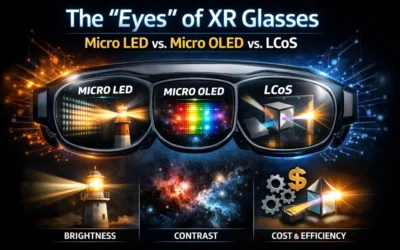
Display Democratization: Full-Color Binocular Goes Mainstream
2026 will be remembered as the year full-color binocular displays enter the consumer mainstream. With price points reaching the ¥3,000-5,000 critical threshold, this technology will transition from early-adopter novelty to accessible utility.
Market Segmentation Emerges:
- Performance-focused: Maximum brightness, field of view, and resolution for specialized applications
- Experience-first: Weight and comfort prioritized, approaching conventional eyewear standards
The driving forces are clear: micro-display chips achieving economy of scale and optical module costs falling through manufacturing optimization.
Perception Evolution: From Recording Device to Environmental Interface
The “always-on camera” is shedding its passive recording role to become the foundational sensor for environmental understanding. This transforms glasses from visual aids into environmental interpreters.
New Interaction Patterns:
- Gaze-as-cursor: Eye tracking enables “look-to-select” interfaces
- Environment-as-display: Physical spaces become interactive surfaces
- Context-as-trigger: Visual focus and dwell time inform intent detection
This evolution is already visible in adjacent products—from camera-enabled headphones to pendant-style recording devices—confirming the industry-wide shift toward perception-first design.
Software Re-architecture: The Rise of Purpose-Built Chips and Real-Time Systems
The architectural revolution that began in 2025 will reach maturity in 2026. The transition from “general-purpose SoCs running Android” to “specialized chip combinations with real-time operating systems” represents a fundamental rethinking of what wearable computing requires.
The New Stack:
- Hardware: Low-power dedicated SoCs + ISP combinations replacing full-featured mobile processors
- Software: RTOS providing deterministic latency and superior power efficiency
- Architecture: Clear edge-cloud division—local sensors and basic AI, complex processing in the cloud
This isn’t a compromise; it’s an optimization for the specific demands of always-worn, always-aware devices.
Development Democratization: Natural Language Programming Unlocks Long-Tail Innovation
Perhaps the most exciting development for 2026 is the democratization of AI glasses application creation. Large language model code generation capabilities are lowering development barriers from professional coders to creative users.
The New Development Paradigm:
- Natural language programming: Users describe desired functionality in plain language
- Micro-application explosion: Lightweight, single-purpose “apps” for specific scenarios
- Personalized workflows: Custom automation sequences generated through conversation
This shift will unlock the long tail of user needs—those specific, personal requirements that traditional app economies could never address profitably.
Market Stratification: Platform Wars and Niche Dominance Coexist
The competitive landscape will crystallize into distinct layers:
| Layer | Players | Focus | Success Metric |
|---|---|---|---|
| Platform | Tech Giants | Defining the AI-native OS and ecosystem | User lock-in, developer adoption |
| Specialist | Hardware-first Brands | Optimizing specific technical approaches (display, audio, form factor) | Technical superiority in chosen domains |
| Vertical | Industry-Specific Providers | Deep integration into professional workflows | Workflow efficiency gains |
This stratified competition creates a healthy innovation ecosystem where platform-level investment trickles down to specialized applications, while vertical solutions pressure platforms to remain flexible.
Manufacturing Implications: The Scalability Challenge
From an OEM/ODM perspective, these trends present both opportunities and complexities. The shift toward specialized architectures requires:
New Manufacturing Capabilities:
- Advanced sensor integration: Cameras, eye trackers, and environmental sensors in miniature form factors
- Thermal management innovations: Dissipating heat from always-on AI processing
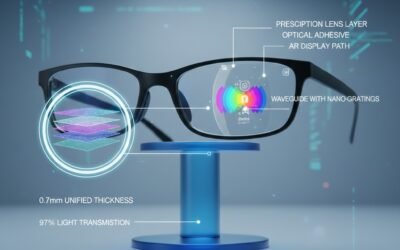
- Precision optical assembly: Maintaining alignment in wearable conditions
Supply Chain Evolution:
- Component sourcing: Securing specialized chips and sensors
- Quality control: Ensuring performance across environmental conditions
- Cost optimization: Balancing capability with mainstream affordability
At Guangzhou ZhuoHao Technology, we’re preparing for this future by developing manufacturing processes optimized for AI-native wearable architectures, helping brands translate these conceptual advances into scalable, reliable products.
Conclusion: The Year of Practical Magic
2026 won’t be the year of technological miracles—it will be the year of practical, integrated intelligence. The focus shifts from “what’s possible” to “what’s usable every day.”
What Consumers Can Expect:
- Affordable full-color displays that don’t compromise comfort
- Proactive, context-aware assistance that feels less like commanding and more like collaborating
- Personalized functionality that adapts to individual lifestyles
What Industry Must Deliver:
- Seamless integration of AI capabilities into natural interactions
- Balanced solutions that don’t sacrifice comfort for capability
- Open yet secure ecosystems that encourage innovation while protecting privacy
The ultimate question for 2026 isn’t whether AI glasses will become more capable—they certainly will—but whether they’ll become more essential to our daily lives. The answer lies not in any single technological breakthrough, but in how thoughtfully these advancements are woven into products that respect both our humanity and our desire for augmentation.
The journey from “seeing better” to “understanding more” begins now.







0 Comments